
Choosing the best gorilla trekking destination between Rwanda, Uganda and DR Congo has always been difficult for travellers because the experience is almost identical in all the 3 countries. However, there are a few distinctive factors that can guide curious travellers to choose their preferred destination for this breathtaking encounter.
Mountain gorillas
Mountain gorillas live only in Africa. They are found in only four countries namely; Uganda, Rwanda and Democratic Republic of Congo (DRC). Their population is divided into two separate groups, one in the Virunga Mountains that straddle the borders of all the 3 countries and the other in Bwindi Impenetrable National Park in southwest Uganda. The number of mountain gorillas is estimated to be about 1063 individual according to the International Gorilla Conservation Program (ICGP) and International Union for Conservation of Nature (IUCN).
Uganda is home to half of the world’s mountain gorilla population with majority of them found in Bwindi Impenetrable Forest National Park, a UNESCO world heritage and a few in Mgahinga Gorilla National Park. The rest of the gorillas live in the Greater Virunga landscape. This area covers about 51000 sq. miles and is shared across the borders of the three countries noticeable as a chain of 8 Virunga volcanic mountains that include two actives volcanoes of Nyiragongo and Nyamuragira located within Virunga National Park a UNESCO world heritage site in eastern DRC.
In addition to Virunga National Park, other gorilla parks in the Virunga Mountains include Volcanoes National Park in northwest Rwanda and Mgahinga Gorilla National Park in southwest Uganda. Each park has a number of habituated gorilla groups which have been tamed and made used to the presence of humans to facilitate gorilla tours and easy monitoring of these giant and endangered primates.
Of the 3 countries, Uganda has the highest number of habituated gorilla families with about 18 of them in Bwindi Impenetrable National Park and 1 in Mgahinga Gorilla National Park. Rwanda’s Volcanoes National Park has 10 habituated gorilla groups while Congo’s Virunga has 8.
Seeing gorillas is considered as one of the best wildlife experiences in the world one can ever get in their lifetime. Gorillas are our closest relatives sharing 98% of the human DNA and this can be evidenced by the human-like behavior they exhibit in their normal life in the wild. This include being led by a father figure known as a silverback, the dominant alpha male heading the entire family. Other members in the family include several females, young males or blackbacks and infants which are usually offspring of the silverback and the females in the group. The average number of gorillas in a group is about 15 members though as low as 2-member groups and as large as 65-member groups have been recorded before in the Virunga Mountains.
Assessing the best gorilla-trekking destination
Who offers more time with the gorillas?
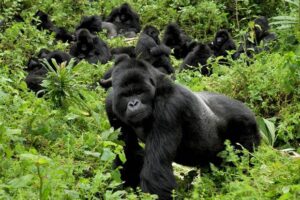 Generally, gorilla trekking experience in Rwanda, Uganda and DR Congo allows visitors to meet fully habituated gorilla families for 1 hour taking photos and observing how the great apes feed and play in the wild. For travelers who would want to spend more time with the gorillas, Uganda offers travelers a chance to take part in the gorilla habituation exercise which lasts four hours in Bwindi Impenetrable National Park. The experience takes place in Rushaga, one of the four gorilla-trekking sectors of Bwindi with the others including Buhoma, Nkuringo and Ruhija.
During the gorilla habituation exercise, visitors trek together with trained trackers and rangers who follow a semi-habituated gorilla group in the wild in order to make the animals get used to the presence of humans. The gorilla-habituation permit is sold at $1,500 per person and the experience is available only in Bwindi Impenetrable National Park.
For more time with gorillas, definitely Uganda is the best destination to visit. However, double-gorilla tracking which can be done in two consecutive days is possible in all mountain gorilla parks.
Every gorilla destination is unique in its own way. To understand which is best, let’s look at factors to consider when planning a gorilla tour. These include the cost of a gorilla permit, ease of a gorilla trek, gorilla lodges where to stay, accessibility, safety and security, other activities in addition to gorilla trekking and the best time to see gorillas.
Cost of the gorilla permit
To see gorillas, one must first book a gorilla permit which is the major item as far gorilla trekking and its overall cost is concerned. In Rwanda a gorilla permit costs $1,500 per person, $700 in Uganda and $500 in DR Congo.
Booking a gorilla permit is done through a tour operator or official authorities namely Uganda Wildlife Authority (UWA) for Uganda, Rwanda Development Board (RDB) and Virunga National Park (Visit Virunga official website). The availability of gorilla permits tends to be limited especially during the peak season (December to February and June to September). Booking in advance at least 3 to 6 months is highly recommended for anyone planning a gorilla tour in any of the 3 countries.
Difficulty in gorilla trekking
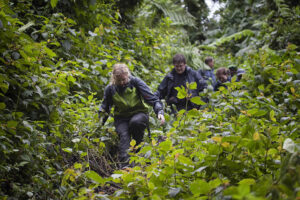 The terrain and vegetation of Virunga region and Bwindi Impenetrable National Park differs. Gorilla parks in Virunga area; that is Volcanoes National Park Rwanda, Mgahinga Gorilla National Park in Uganda and Virunga National Park in DR Congo comprise of volcanic mountains with an altitude range of 2600 to 4000 meters above sea level. While Bwindi’s altitude range is 1100 to 2000 meters above sea level.
The vegetation in Volcanoes and Mgahinga parks for instance is made of tropical and bamboo forests while Bwindi and Virunga have dense tropical forests with steep valleys and thick undergrowth.
With that in mind, hiking to see gorillas is a true physical challenge. One should prepare physically, mentally and prepare the right gear for this breathtaking adventure.
Some of the most essential gear for gorilla trekking include hiking boots, pair of hard trousers, long-sleeved shirt, a rain jacket, and a pair of gloves. Others include a cap, drinking water, a walking stick and snacks which are usually provided at the lodge booked for accommodation.
Gorilla treks in Bwindi and Virunga National Parks are more physically-demanding compared to Volcanoes National Park in Rwanda whose relatively gentle landscape and less dense vegetation eases accessibility to gorillas. This also means that the average time taken to meet gorillas in Rwanda is less (2-4 hours) compared to Bwindi and Virunga where it may go up to 6 hours. compared Rangers lead visitors on a tree and time it takes to hike on foot, search and located the gorillas range from 1 hour up to 8 hours.
What about security
Rwanda and Uganda are safe and secure to visit for gorilla tours and other safaris at any time of the year. There’s a high level of security provided by wildlife rangers and tourism police in and around gorilla parks like Bwindi and Volcanoes National Park.
On the other hand, Virunga National Park is safe for gorilla trekking but the security situation is fragile around the park due to long-standing civil conflicts in north and south Kivu provinces of eastern Democratic Republic of Congo. However, since the establishment of Congolese Institute for Conservation of Nature (ICCN), Virunga rangers have managed to secure the park though many have lost their lives in the line of duty. Travelers visiting Virunga National Park for gorilla tours and other experiences are escorted by rangers from Goma city to the park. It is recommended for travelers to first inquire or get updated about the security situation around the park before visiting or booking safaris to Virunga.
Accommodation
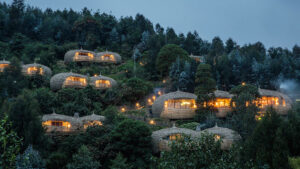 Rwanda is increasingly developing into a high-end tourist destination and its accommodation facilities like lodges and hotels are developed on that concept. Most of the lodges and hotels around tourist destinations like national parks are luxury and midrange with a few budget facilities. Uganda has a mixed range of accommodation facilities with all luxury, midrange and budget available at all the country’s tourist destinations and in major cities and towns.
In a nutshell, all travelers can find accommodation suiting their budget at their corresponding safari destinations.
Travelers aiming for gorilla trekking are encouraged to book accommodation at facilities near their trekking destinations. This helps to eliminate any inconveniences which may cause delay because the experience starts very early in the morning, kicking off with the briefing of trekkers which is done at park headquarters.
In Rwanda, most lodges are close to Volcanoes National Park as well as in Bwindi. In Mgahinga, the lodges are at a distance of almost 10 km away from Ntebeko gorilla center, the main starting point for gorilla treks in the park.
Virunga National Park has got limited accommodation facilities compared to other gorilla-trekking destinations. There are fewer lodges including Mikeno Lodge, luxury facility found inside the park while the rest of the lodges like Tchegera Island Tented Camp, Bukima Lodge are located some distance away from the park.
Accessibility to gorilla parks
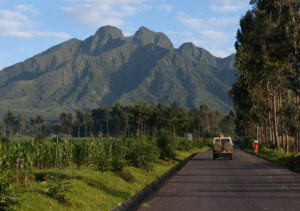 In Uganda, Bwindi and Mgahinga parks can be accessed both by road and air through charter flights.
Setting off from Kampala to Bwindi by road to is long journey of about 10 hours but has a lot to offer along the way for viewing such as the Equator experience, photography, cultural and lunch stops.
Travelers can also book fly-in gorilla tours to Bwindi to save themselves from the exhausting long drive. Light charter flights from Entebbe airport or Kajjansi airstrip take an hour or less to reach Kisoro airstrip in Kisoro district and Kihihi airstrip in Kanungu district.
From Kihihi, the easiest gorilla centers to reach are Buhoma (north of Bwindi) and Ruhija (east of Bwindi) in about 30 to 45 minutes of driving on tarmac roads.
From Kisoro airstrip you access Rushaga and Nkuringo the southern sectors of Bwindi. The drive lasts between 10 to 30 minutes depending on the location of your booked lodge for accommodation.
For gorilla tours in Mgahinga Gorilla National Park, flying in at Kisoro airstrip is the best option with the nearest accommodation center a 1 hour drive away.
On the other hand, getting to Volcanoes National Park from Kigali city takes about 2-hours’ drive. There’s an option to fly in by charter plane operated by Akagera Aviation to Musanze airstrip. The drive time from Musanze airstrip is less than 15 minutes to reach most of the lodges. One and Only Gorilla Nest Lodge has a helipad for those sleeping there.
Going to Nyungwe Forest National Park for chimpanzee tracking and canopy tour, the flight from Kigali takes you to Kamembe airstrip which is about 30 to 40 minutes’ drive to the accommodation centers.
Getting to DR Congo Virunga National Park; travelers can fly direct to Goma International Airport in Goma, the largest city in eastern DR Congo. Alternatively, travelers land at Kigali International Airport and drive about 3 to 4 hours to Grand Barrier Border post and then check-in at the immigration office to cross over to Goma city. Driving from Goma city to Virunga National park takes between 90 minutes to 2 hours.
Other experiences in addition to gorilla trekking
In Virunga National Park, visitors can go for Nyiragongo volcano hike. If staying at Mikeno Lodge, visit Senkwenkwe gorilla orphanage sanctuary to see gorillas in captivity. If staying at Tchegera Island Tented Camp, the lodge offers boat rides and other water sport activities on Lake Kivu.
In Bwindi forest there are several village-walks in all the sectors that offer a chance to meet locals, shop souvenirs to support the local community tourism projects like handicrafts such as Ride 4 a Woman center. Buhoma sector has a cultural experience where you interact with locals as they showcase their culture through music, dance and drama.
In Mgahinga Gorilla National Park, there’s a Batwa trail which offer visitors a chance to meet the Batwa pygmies and learn their ancient lifestyle. The Batwa trail and cultural experience takes about 6 hours from start to finish.
There are also boat rides, canoeing, zip lining and birding at lake Bunyonyi, Lake Mutanda and Lake Mulehe.
The activities to do in Volcanoes National Park after gorilla trekking are cultural experiences at Iby’iwacu Cultural Village, boat rides and birding at twin Lakes of Burera and Ruhondo
Africa Adventure Safaris is your best guide on your gorilla safari to Africa.