
Traveling with children as a family is one of the best moments you can have on a trip. The fun stories and jokes cracked by children will surely make your safari memorable. However before traveling with kids, you must first know which travel activities are eligible for children for proper planning. Children in this regard are those people below 15 years old. Africa Adventure safaris offers you a list of best travel activities for children in Rwanda. Whereas as mountain gorillas in Volcanoes National Park are the main tourist attractions for Rwanda,children below 15 years cannot participate in gorilla trekking activity due to age restriction. For other activities, visiting Rwanda with children is okay given that the country is safe both in terms of crime and handling the covid-19 pandemic. There has been tremendous transformation in terms of development that has taken place since the 1994 genocide against Tutsi. Rwandans openly talk about the good and bad side of events that led to the civil war in which 800000 people horribly lost their lives within a 100 days – you can watch the film “Hotel Rwanda”. The leadership and the culture people of Rwanda who are comprised of only three ethnic tribes including Tutsi (cattle keepers), Hutu (farmers) and a few Batwa pygmies (forest hunter gatherers) has put much emphasis on sustainable development especially urban tourism.
About 28 years later, Kigali city is now positioned as a clean beautiful urban area due to good education policy that Rwandan way of living has turned industrious, technology and development of roads with palm trees along the conferences and meetings avenues in Nyarugenge the city center including Kigali Convention Center, Radisson Blu and Marriott hotel chains and several boutique hotels. The same goes for recreational facilities which have come up including genocide memorials, museums and art galleries, theaters and concert venues, shopping centers among others. Rwandans are habitually becoming artistic, social and fun loving.
Under this influence, the town took shape and so Kigali and its neighborhoods including Nyarutarama is a tight community of modern residential buildings, narrow artistic European streets adhering to its hilly landscape making Rwanda “the land of a thousand hills”. In general, Rwanda is a destination for travelers looking to see a positive modern facet Africa lifestyle than a preconceived “poor rural Africa”. Kigali city sightseeing tour when tailored to needs of those visiting Rwanda with children offers a chance to experience Rwandan traditional customs without traveling upcountry including visiting Kimironko market, Kandt house museum of natural history and art galleries, a school for children to take part in English classes, a workshop to have a local dress made for you or an art gallery for souvenir shopping.
Furthermore, activities for children in Rwanda are not found in a single place. Visitors have to follow an itinerary, drive a car, bus for traveling upcountry or take fly in safari with Akagera Aviation to different destinations. Though, the quality of the roads has improved and driving in Rwanda is smooth and safe, some upcountry areas still have dirt roads. This is especially for game tracks inside Akagera National Park, you expect rough, dusty and hot drives. Those traveling with young children need to pack items including sunhat, sunscreen and insect repellant among others such as food and anti-malarial medication to provide comfortable sitting while in a vehicle. There are food and rest stops along major tourist routes including Nyirangarama on the way to Akagera where locals offer goat kebabs and spicy potatoes an alternative to McDonalds or Starbucks). The national parks of Rwanda too allow children of any age especially Akagera in the eastern side offers game viewing with a chance for kids to spot Big 5 mammals including lions and African elephants. The Nyungwe Forest National Park is home to the canopy walkway in East Africa which is suitable for children of 6 years and offers spectacular view of the Albertine rift valley.
Places for best activities to do with children in Rwanda
The Gorilla Guardians Village
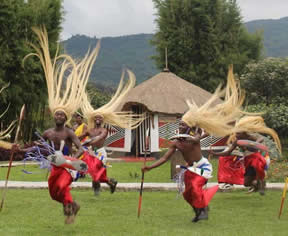 Formerly known as Iby’iwacu, the village is situated at the edge of Volcanoes National Park in Musanze district northern province about 168 sq.km (2-hour drive) north of Kigali capital city. The 169 sq.km protected area is part of Virunga massif famous for harboring endangered mountain gorillas. The people living near the park naturally depended on the forest for survival including hunting wild animals for bushmeat consumption. When poaching was banned in Rwanda due to strict laws, the cultural village near gorillas was established in 2005 as non-profit organization with aim of improving the lives ex-poachers. In relation to gorilla conservation, rural tourism in Musanze provides opportunity for jobs and many locals in the village have been able to make income to support their families. Iby’Iwacu offers interactive cultural activities suitable for children such as dance performances, lessons on basket weaving and among others such as how to shoot an arrow that hunters use, and playing the roles of marriage ceremony king and Queen with photoshoot and a traditional homestay experience. Farm tours are available for those interested in preparation of local food and banana beer brewing process. The cultural tour can be done in the evening after doing some of the activities in Volcanoes National Park including gorilla trekking, Dian Fossey hike and Karisimbi volcano hiking among others such as golden monkey tracking activity. Lake Kivu is 58 sq.km (2-hour drive) south-west of Musanze town and offers off the beaten path beach vacation in Rwanda.
Lake Kivu
Lake Kivu is one of the seven African Great Lakes shared between western Rwanda and east of Democratic Republic of Congo (DRC). The lake extends for 70 sq.km long with average depth of 240 meters and tropical islands including Idjwi support rich in biodiversity including the straw-colored fruit bats listed as threatened on IUCN, over 28 tropical fish species including longfin tilapia which attract birds of prey such as Osprey. Due to economic trade between Rwanda and DR Congo, the northern shores of Lake Kivu have attracted development of urban centers including Gisenyi (Rubavu) and Karongi which have turned into tourist spots for beach vacation in Rwanda. In particular, Gisenyi town not only hosts a diverse population of people from across the Great Lakes Region making for a multicultural experience but also offers lakeside resort hotels and beach bars with child friendly recreational facilities including swimming pools, kayaking, fishing and boat rides. Adults can go swimming in the lake given that there are no crocodiles or Bilharzia along the Rubavu Public Beach.
Akagera National Park
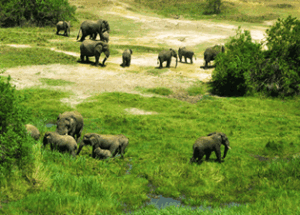 Akagera National Park is 105 sq.km (3-hour drive) east of Kigali capital city along the border with Tanzania. The park is Rwanda’s only savannah protected area covering 1122 sq.km that consists of short and tall grass savannah, rolling hills and Akagera river which fills several swamps and 10 lakes including Lake Ihema the largest. The park is rich biodiversity including Big 5 African mammals (lions, leopards, African elephants, Cape buffalo, eastern black and southern white rhinos) among others such as plains zebra, Masai giraffe, kobs, hippos and over 500 species of birds. Guests can enjoy searching wild animals in the African bush through day and game drives, boat cruises and sport fishing on the lake. Children below 5 years do not pay park entrance fees and are allowed on game drives and boat cruise. Besides, game viewing visitors can take children for a walk around the village which offers authentic cultural interaction including food crop harvesting and history of the park through “behind the scenes experience” at the park visitor center. The history of Akagera National Park is an interesting story of successful wildlife conservation in Rwanda. Poaching during the 1994 Rwandan genocide led to extinction of lions and black rhinos. In an effort to restore the lost wildlife, the government of through Rwanda Development Board (RDB) entered into a long-term partnership with African Parks Network (AP) to manage the park. The Akagera Management Company has since 2015 restored lions, black and white rhinos and effective anti-poaching efforts including a fence along the northern border of the park keeps the animals safe. Akagera is now a big five safari destination offering off-the-beaten path game viewing.
Nyungwe Forest National Park
Nyungwe Forest National Park is an Afromontane tropical rainforest covering 970 sq.km in the Albertine Rift Valley. The park is 218 km (5-hour drive) south-west of Kigali capital city and can be accessed by air through Kamembe airport which is 56 km (1-hour drive) away from Uwinka visitor center in the center of the protected area. Given its location, Nyungwe Forest National Park is rich in biodiversity with 13 primate species including chimpanzees, black and white colobus monkeys, red colobus monkeys, Hamlyn’s monkey, red-tailed monkeys and blue monkeys and over 300 species of birds of which 16 are Albertine Rift Endemics including strange weaver and red-faced woodland warbler. Chimpanzee trekking is the main activity and children below 15 years of age are not allowed to take part in the primate walk. Activities for children in Nyungwe Forest National Park include a canopy walkway for kids of 5 years and above. The canopy bridges are 50 to 70 meters high above the ground with opaque walkways to limit the fear of heights and offer spectacular aerial view of the forest. Alternatively, visitors can take children for a community walk including visiting Gisakura tea plantations and Banda cultural village which offers a demo on basket weaving and banana beer brewing activity, local food preparation and tasting, guided farm tours and Rwandan traditional dance performances.